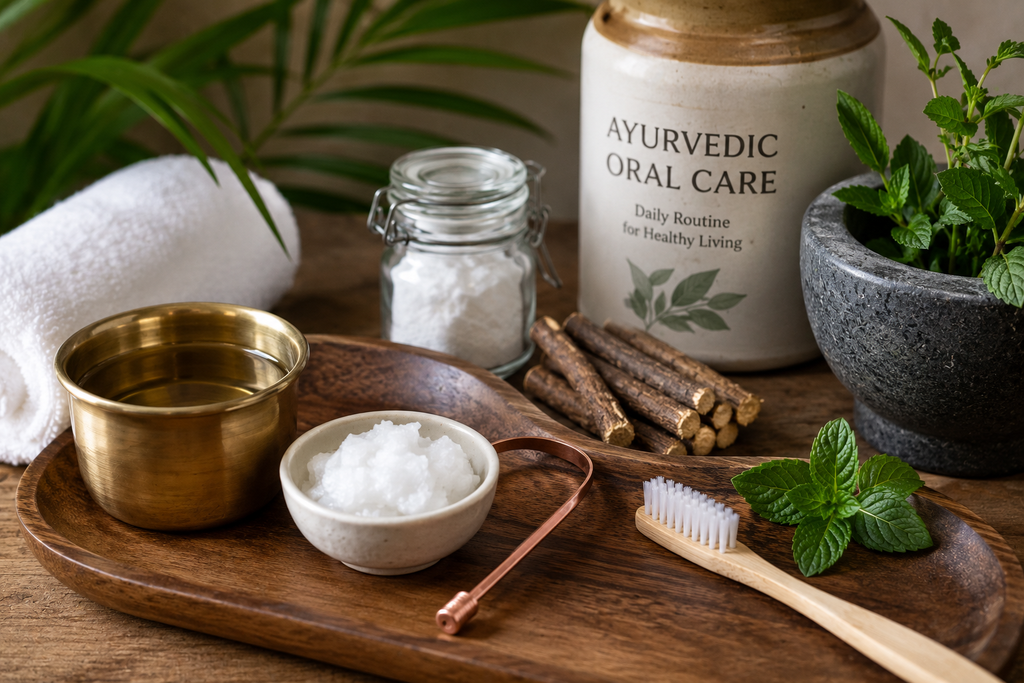
We often think about health in terms of digestion, sleep, weight, blood pressure, or mental well-being. But one part of the body is sometimes overlooked until something goes wrong: the mouth.
Our mouth is involved in eating, speaking, breathing, social interaction, and overall quality of life. Oral diseases are also among the most common health conditions worldwide. The World Health Organization estimates that oral diseases affect billions of people globally, with dental caries and periodontal disease being major contributors to pain, tooth loss, and reduced quality of life.Ayurveda has traditionally placed considerable emphasis on daily oral care through Dinacharya, the Ayurvedic framework for maintaining healthy daily habits. Practices such as Dantadhavana (cleaning the teeth), Jihva Nirlekhana (tongue cleaning), and Gandusha/Kavala (oil or liquid-based oral practices) have been incorporated into traditional routines. But how should we understand these practices today? The most useful approach is neither to dismiss traditional practices nor to claim that they can replace modern dentistry.
Instead, we can ask: Which Ayurvedic oral-care practices are potentially useful, what does current evidence tell us, and how can they be integrated safely with modern dental care?
Why Oral Health Matters Beyond the Teeth
Oral health is not simply about having clean teeth. The WHO defines oral health as a state that allows individuals to eat, breathe, speak, and participate socially without pain or discomfort. Poor oral health can affect:
- Eating
- Sleep
- Concentration
- Communication
- Social confidence
- Quality of life
There are also important connections between oral health and systemic health. For example, diabetes is associated with the development and progression of periodontal disease, while tobacco, alcohol, and diets high in free sugars contribute to multiple noncommunicable diseases as well as oral disease. This makes oral care an important component of preventive health.
Ayurveda and Dinacharya
Ayurveda approaches health partly through the concept of Dinacharya, or daily routine. The idea is straightforward: Rather than waiting for symptoms to appear, develop habits that support physiological function every day.
Traditional Ayurvedic daily routines include attention to:
- Oral hygiene
- Tongue cleaning
- Elimination
- Exercise
- Food
- Personal hygiene
- Mental well-being
- Sleep
The emphasis is on regularity. This is particularly relevant today because modern lifestyles often encourage irregular meals, excessive processed foods, smoking, alcohol consumption, sedentary behavior, and inconsistent routines.
Dantadhavana: Traditional Tooth Cleaning
Ayurveda describes Dantadhavana, or cleaning the teeth, as part of daily routine. Traditional methods included the use of plant-based chewing sticks from selected medicinal plants. The important principle is not that everyone today should abandon their toothbrush. Rather, the traditional practice highlights something that modern dentistry also emphasizes: regular mechanical removal of plaque is essential.
The WHO recommends brushing twice daily with fluoride-containing toothpaste containing approximately 1000–1500 ppm fluoride. Therefore, for modern oral care: Ayurvedic principles can complement—not replace—evidence-based toothbrushing.
Jihva Nirlekhana: Tongue Cleaning
One of the most recognizable Ayurvedic oral-care practices is Jihva Nirlekhana, or tongue cleaning. The tongue can accumulate a coating consisting of bacteria, food debris, epithelial cells, and other material. Tongue cleaning may help improve oral cleanliness and reduce some causes of unpleasant breath. A tongue scraper can be used gently from the back toward the front. The key word is: gently.
There is no benefit to aggressively scraping the tongue until it becomes irritated. Tongue cleaning should not cause:
- Bleeding
- Significant pain
- Persistent irritation
- Tissue damage
If these occur, the practice should be stopped and the underlying problem assessed.
Gandusha and Kavala
Ayurveda describes two traditional approaches involving holding or moving liquids within the mouth: Gandusha generally refers to retaining a substance in the mouth without active movement. Kavala involves holding and moving the substance within the oral cavity. Different substances have traditionally been used depending on the Ayurvedic context. Oil-based oral practices have attracted considerable modern interest, particularly oil pulling. But this is where evidence-based interpretation becomes important.
What Does the Evidence Say About Oil Pulling?
Oil pulling has become extremely popular online. It is sometimes promoted as a treatment for everything from dental disease to systemic “detoxification.” Those claims go beyond the available evidence. A recent systematic review examining traditional oral-hygiene practices such as oil pulling and miswak found evidence suggesting potential short-term effects on plaque and gingival outcomes, but also highlighted limitations in the available research, particularly regarding longer-term outcomes and comparison with established oral-hygiene methods. Therefore, oil pulling may be considered a complementary oral-hygiene practice, but it should not replace:
- Toothbrushing
- Fluoride toothpaste
- Interdental cleaning where appropriate
- Professional dental examinations
- Treatment of cavities
- Treatment of periodontal disease
Most importantly, there is insufficient evidence to describe oil pulling as a systemic “detox” procedure.
Why Fluoride Still Matters
There is sometimes an unnecessary conflict between Ayurveda and fluoride. From a modern dental perspective, fluoride plays an important role in preventing dental caries. The WHO specifically recommends twice-daily brushing with fluoride-containing toothpaste. Therefore, someone interested in Ayurveda does not need to reject fluoride-containing toothpaste. An integrative approach can look like:
Morning:
Brush with fluoride toothpaste → tongue cleaning → other individualized Ayurvedic oral-care practices if appropriate.
Evening:
Brush with fluoride toothpaste → interdental cleaning as advised.
This preserves the evidence-based foundation while allowing room for traditional practices.
Diet Is One of the Most Important Ayurvedic Oral-Health Principles
Oral health is not determined only by what happens in the bathroom. Diet matters. Dental caries develops when bacteria in dental plaque metabolize sugars and produce acids that progressively damage tooth structure. The WHO identifies free-sugar consumption as a major risk factor for dental caries and recommends limiting free sugars to less than 10% of total energy intake, with additional benefit from keeping intake below 5%. This is an important area where modern preventive dentistry and Ayurvedic dietary philosophy can overlap. Ayurveda generally emphasizes appropriate food quantity, quality, timing, digestibility, and individual suitability.
From an oral-health perspective, practical principles include:
- Reduce frequent sugary snacks.
- Limit sugar-sweetened beverages.
- Prefer water as the main drink.
- Avoid continuously sipping sweetened drinks throughout the day.
- Choose nutrient-dense whole foods.
- Maintain regular meals rather than constant grazing.
The issue is not only how much sugar you consume.
How frequently the teeth are exposed to free sugars also matters.
Don’t Ignore Bad Breath
Bad breath, or halitosis, is often treated as a cosmetic problem. Sometimes it is simply related to food or oral hygiene. But persistent bad breath can also be associated with:
- Gum disease
- Dental caries
- Dry mouth
- Tongue coating
- Certain infections
- Tobacco use
- Some systemic conditions
Ayurvedic tongue examination and oral assessment may provide useful observational information, but persistent symptoms should be evaluated appropriately. If bad breath continues despite good oral hygiene, a dental examination is a sensible next step.
Oil Is Not Always Better
Ayurveda uses oils extensively, but “natural oil” does not automatically mean “appropriate for every person.” People may have different responses to oral oils.
If someone experiences:
- Nausea
- Choking
- Jaw discomfort
- Oral irritation
- Difficulty managing the oil
they should discontinue the practice. Oil pulling should also never be performed in a way that creates a risk of aspiration. Children and people who have difficulty controlling swallowing should receive particularly cautious guidance.
Oral Health and the Ayurvedic Concept of Agni
Ayurveda frequently connects health with Agni, the functional principle of digestion and metabolism. It is tempting to translate every oral-health issue directly into “weak Agni.” That would be an oversimplification. A dental cavity is not simply the result of poor digestion. Periodontal disease cannot be reduced to one Dosha. Modern oral diseases have identifiable biological mechanisms and risk factors.
However, Ayurveda’s broader emphasis on:
- Food quality
- Eating habits
- Daily routine
- Hygiene
- Lifestyle
- Individual constitution
can contribute to a more holistic health framework. The key is to use Ayurvedic concepts thoughtfully rather than forcing every modern disease into a single Ayurvedic explanation.
Ayurveda and the Mouth-Gut Connection
The mouth is the beginning of the digestive tract. Food is mechanically processed in the mouth, mixed with saliva, and prepared for swallowing and further digestion. This makes oral health naturally relevant to Ayurveda’s broader interest in Ahara and digestion. But it is important to distinguish a meaningful physiological connection from exaggerated claims. Good oral health supports comfortable eating. Good nutrition supports oral tissues. And dietary patterns influence both oral and systemic health. This is a practical, evidence-compatible connection that does not require extraordinary claims.
A Simple Ayurvedic-Inspired Morning Oral Routine
You can keep your routine simple.
Step 1: Hydrate
Drink water according to your thirst and individual needs.
Step 2: Clean the teeth
Brush twice daily using fluoride-containing toothpaste, as recommended by WHO.
Step 3: Clean the tongue
Use a tongue scraper gently if it suits you.
Step 4: Optional traditional practice
If appropriate for you, an Ayurvedic oral practice such as Gandusha or Kavala may be incorporated as a complementary habit.
Step 5: Eat mindfully
Avoid making sugary drinks and frequent sweet snacks a routine part of the day.
Step 6: Don’t forget dental care
Regular dental examinations remain essential.
When Should You See a Dentist?
Ayurvedic self-care should never delay professional dental evaluation.
See a dentist if you have:
- Persistent toothache
- Tooth sensitivity
- Bleeding gums
- Swollen gums
- Loose teeth
- Persistent bad breath
- Oral ulcers that do not heal
- Difficulty chewing
- Facial or jaw swelling
- Changes in oral tissue
- A broken tooth
Oral cancer is another important reason not to ignore persistent changes in the mouth. Tobacco, alcohol, and areca-nut use are among the major risk factors for oral cancer.
The Integrative Approach to Oral Health
The strongest approach is not:
Ayurveda versus dentistry.
It is:
Ayurveda + evidence-based dentistry + healthy lifestyle.
A practical integrative oral-health strategy could include:
Modern evidence-based foundation
- Fluoride toothpaste
- Twice-daily brushing
- Interdental cleaning where appropriate
- Professional dental assessment
- Appropriate treatment of dental disease
Ayurvedic lifestyle support
- Tongue cleaning
- Appropriate traditional oral-care practices
- Attention to diet and meal habits
- Daily routine
- Stress management
- Individualized lifestyle practices
General preventive health
- Avoid tobacco
- Avoid areca nut
- Moderate alcohol consumption
- Reduce free sugars
- Maintain appropriate physical activity
- Manage chronic conditions such as diabetes
This approach respects both traditional knowledge and modern evidence.
Practical Takeaways for Better Oral Health
If you want to improve your oral-health routine, start with these seven habits:
- Brush twice daily with fluoride toothpaste.
- Clean your tongue gently.
- Reduce frequent exposure to sugary foods and drinks.
- Don’t smoke or chew tobacco/areca nut.
- Consider traditional Ayurvedic oral practices as complementary, not replacement therapies.
- Pay attention to persistent symptoms such as bleeding gums or bad breath.
- Maintain regular professional dental care.
You do not need an elaborate routine. Consistency matters more than complexity. Ayurveda’s traditional approach to oral care offers an interesting example of how ancient health practices can be thoughtfully integrated into modern preventive healthcare. Practices such as Dantadhavana, Jihva Nirlekhana, Gandusha, and Kavala reflect Ayurveda’s long-standing emphasis on daily oral hygiene. Modern dentistry provides strong evidence for other essential measures, particularly fluoride toothpaste, regular toothbrushing, appropriate interdental care, professional assessment, and management of risk factors such as excess sugar and tobacco. The most sensible approach is therefore not to choose between tradition and modern dentistry. It is to use each where it is most useful.
Traditional wisdom can inform the routine.
Modern evidence can define the safety boundaries.
Professional dental care can diagnose and treat disease.
Together, these can form a more complete approach to oral health.
Ready to Make Oral Health Part of Your Ayurvedic Routine?
Start with the basics: clean your teeth, clean your tongue, eat mindfully, reduce unnecessary sugar exposure, maintain healthy daily routines, and seek professional care when symptoms persist.
Small daily habits can make a meaningful difference over the course of a lifetime.
Medical Disclaimer
This article is intended for education and general wellness information. It does not replace professional dental diagnosis or treatment. Ayurvedic oral-care practices should be used as complementary measures rather than substitutes for evidence-based dental care. Individuals with dental disease, persistent oral symptoms, or medical conditions should consult an appropriately qualified healthcare professional.
Sources: World Health Organization oral-health guidance and recent systematic-review evidence on traditional oral-hygiene practices.