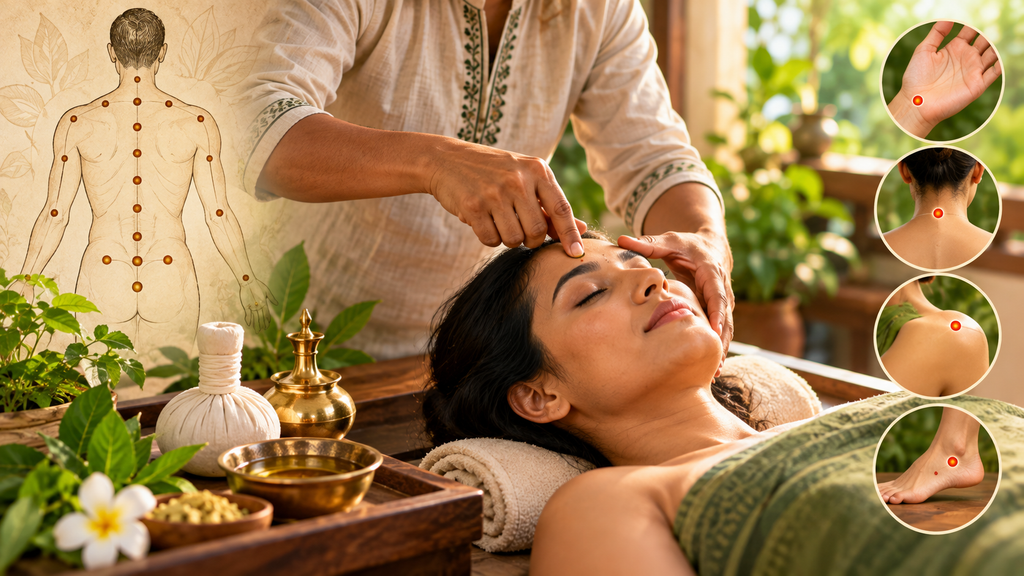
Have you ever noticed that pressing or massaging a particular point on your body can produce a sensation that feels very different from pressing the surrounding area? Perhaps it is a point around the shoulder that feels unusually tender, or an area on the foot, palm, neck or head that seems connected to a deeper sensation. Ayurveda has explored the significance of specific anatomical locations for centuries through the concept of Marma. Marma therapy is increasingly attracting attention outside traditional Ayurvedic practice and is being used in wellness centres, yoga settings, massage practices and integrative health programs, often described as a therapy involving the body’s “vital points.” But what exactly is a Marma point? Is Marma simply another form of acupressure? Can stimulating Marma points really influence pain, stress or other health problems? And perhaps most importantly, what does modern evidence actually tell us? Let’s take a closer look.
What Is a Marma Point?
The word Marma comes from the Sanskrit root associated with something vulnerable, vital or sensitive. Classical Ayurvedic texts describe 107 Marma points distributed throughout the body. These points are traditionally associated with important anatomical structures and are described in relation to muscles, blood vessels, ligaments, bones and joints. The classical description of Marma is therefore much more sophisticated than simply saying that these are “pressure points.” Marma points represent locations where anatomy, physiology and the traditional Ayurvedic understanding of life intersect. They were also historically associated with trauma and battlefield medicine because injury to certain regions could have serious or even life-threatening consequences. This historical context is important because Marma was not originally developed simply as a relaxing massage technique; it is part of a much broader Ayurvedic understanding of the body.
Marma and Prana
One of the traditional concepts associated with Marma is Prana, often translated as vital life force. In the Ayurvedic framework, Prana is associated with life, movement, respiration, neurological function and the maintenance of vitality. Marma points are traditionally regarded as important locations through which disturbances in the body may manifest and through which therapeutic stimulation may influence the functional balance of the individual. However, it is important to understand the language correctly. Prana is an Ayurvedic concept and should not automatically be equated with a specific structure such as a nerve, blood vessel or electrical current. Modern physiology and Ayurveda use different explanatory systems. That does not mean the traditional concept has no value; it means that we should avoid claiming that modern science has already “proven” Prana in biomedical terms.
Are Marma Points the Same as Acupuncture Points?
This is one of the most common questions. The short answer is no. Marma points and acupuncture points can sometimes appear anatomically similar, and both traditions involve specific locations on the body, but they developed within different medical systems and have different theoretical foundations. Marma belongs to Ayurveda, while acupuncture belongs to Traditional Chinese Medicine. Their concepts of anatomy, energy, diagnosis and treatment are not identical. Comparative research has examined similarities and differences between Marma points and acupuncture points, but anatomical overlap should not be interpreted as proof that the two systems are the same. It is more accurate to appreciate each system within its own historical and medical framework.
Why Are Marma Points Considered Important?
Traditionally, Marma points are classified according to the structures involved and the consequences of injury. Classical Ayurveda describes Marma according to categories such as Mamsa Marma, Sira Marma, Snayu Marma, Asthi Marma and Sandhi Marma, referring broadly to muscle, vascular structures, connective structures, bone and joint involvement. They are also classified according to the consequences of injury, including points where trauma could result in immediate death, delayed death, serious disability or significant pain. This makes Marma particularly interesting from an anatomical perspective because it shows that ancient Ayurvedic physicians paid considerable attention to specific vulnerable regions of the human body.
Marma Therapy Is Not Simply “Press Hard on a Point”
This is an important misconception. Marma therapy should not be reduced to aggressive pressure. The technique can involve gentle touch, sustained pressure, massage, circular movements, oil application, awareness of the area and other individualized approaches depending on the practitioner and therapeutic objective. The intensity should be appropriate to the individual. A painful point is not necessarily a point that needs to be pressed harder. In fact, aggressive stimulation can be inappropriate, particularly around vulnerable anatomical structures. This is why Marma therapy should ideally be performed by someone who understands both the traditional Marma system and relevant anatomy.
What Happens During a Marma Session?
There is no single universal Marma session. The approach may vary depending on the purpose of treatment, the individual’s condition, the Marma points selected and the practitioner’s training. A typical session may begin with an assessment of the individual’s symptoms, physical condition and relevant Ayurvedic factors. The practitioner may then select specific Marma regions. Gentle pressure or massage may be applied, sometimes using an appropriate Ayurvedic oil. The person may be asked to breathe slowly and pay attention to sensations in the body. Some people experience relaxation during the session, while others may notice localized tenderness, warmth, heaviness, lightness or a change in muscular tension. These experiences can vary considerably between individuals.
Can Marma Therapy Help With Pain?
Pain management is one of the areas in which Marma therapy has attracted clinical interest. There are early studies and clinical reports exploring Marma-based approaches for conditions involving pain and functional limitations. However, the quality and quantity of evidence remain limited compared with well-established medical treatments. A 2026 randomized controlled trial protocol is evaluating Marma therapy for lumbar disc herniation with radiculopathy. The researchers specifically noted that rigorous evidence for Marma therapy in this condition remains limited and that the study is intended to evaluate both efficacy and safety. This is an important distinction. A clinical trial being conducted does not mean that the treatment has already been proven effective. It means researchers consider the question important enough to investigate. That is exactly how responsible evidence-based medicine should work.
What About Stress and Relaxation?
Many people report feeling relaxed after massage-based therapies. There are several possible explanations. Gentle touch, focused attention, breathing, a quiet environment and reduced muscular tension can all contribute to relaxation. Marma therapy may therefore be incorporated into a broader wellness program focused on relaxation and body awareness. But again, it is better to avoid exaggerated claims such as “Marma therapy resets the nervous system” or “activates every organ.” Those statements go beyond what current evidence can establish. A more reasonable statement is that Marma-based touch and massage may support relaxation and body awareness, while research continues to explore specific therapeutic effects.
Marma and the Nervous System
The connection between touch and the nervous system is particularly interesting. The skin contains numerous sensory receptors that respond to pressure, temperature, movement and touch. Stimulation of these receptors sends signals through the peripheral nervous system to the central nervous system. Massage and tactile stimulation can therefore influence sensory processing, muscle tone, relaxation and the subjective experience of pain. This does not mean that every Marma point corresponds to a specific nerve or brain centre. Rather, it provides a possible modern physiological context for understanding why focused touch may produce meaningful sensations. The traditional Ayurvedic explanation and the modern physiological explanation do not have to be forced into being identical; they can be studied separately.
Marma as a Mind-Body Practice
One of the most interesting possibilities of Marma therapy is its potential role as a mind-body practice. Modern life often disconnects people from their physical sensations. We sit for hours, work on computers, scroll through phones and often eat while watching screens. We may notice the body only when something hurts. A structured Marma session can encourage a person to slow down and consciously experience different parts of the body. That awareness itself may be valuable. This is particularly relevant when Marma is combined with appropriate breathing, yoga, meditation and lifestyle practices.
Can You Stimulate Marma Points Yourself?
Some gentle forms of self-care may be appropriate when taught correctly. However, self-stimulation should not mean randomly pressing sensitive points on the body. A basic principle is: gentle awareness is different from aggressive pressure. For general wellness, gentle massage of areas such as the hands, feet or scalp may be appropriate for many healthy individuals. However, people with significant medical conditions, recent injuries, neurological problems, vascular disorders, pregnancy-related concerns or other specific health issues should seek appropriate professional advice before using therapeutic Marma techniques. Certain Marma regions are anatomically sensitive and should not be manipulated casually.
What Marma Therapy Is Not
Marma therapy should not be presented as a cure for every disease. It should not replace emergency medical treatment. It should not be used instead of appropriate investigation for unexplained pain, neurological symptoms, chest pain, severe headache or other potentially serious conditions. It should not be marketed with claims that stimulating one point can “detox the liver,” “balance all hormones” or cure complex diseases without appropriate clinical evidence. The strength of Ayurveda is not that every traditional concept needs to be converted into a modern medical claim. Its strength can also lie in the way it encourages individualized observation, body awareness, therapeutic touch and integration of lifestyle with treatment.
Marma Therapy and Modern Research
The evidence base for Marma therapy is still developing. Older research includes pilot work exploring Marma therapy in stroke rehabilitation, where the study suggested feasibility and acceptability but did not establish definitive effectiveness. More recent research is attempting to move toward better-designed clinical trials. For example, a 2026 randomized trial protocol is evaluating Marma therapy for lumbar disc herniation with radiculopathy. This reflects growing interest in testing traditional practices using contemporary research methodology. However, systematic and narrative reviews of Ayurveda consistently highlight broader challenges in the evidence base, including small sample sizes, differences between treatment protocols, difficulty standardizing individualized interventions and limited long-term safety data.
Therefore, the appropriate scientific position today is neither “Marma is proven to cure disease” nor “Marma has no value because it is traditional.” The more accurate position is: Marma is a traditional Ayurvedic therapy with interesting clinical possibilities, but more high-quality research is needed to establish its effectiveness, mechanisms and safety for specific conditions.
Why Training Matters
Because Marma points are associated with important anatomical structures, knowledge matters. A practitioner should understand where the points are located, what structures lie beneath them, how much pressure may be appropriate and when a particular point should be avoided. Marma therapy should therefore not be reduced to a list of 107 points memorized from a chart. True clinical application requires understanding anatomy, Ayurvedic principles, indications, contraindications, assessment, touch and pressure techniques, clinical reasoning and patient safety. This is particularly important when Marma is used therapeutically rather than simply as a relaxation technique.
The Future of Marma Therapy
Marma therapy sits at an interesting intersection between traditional knowledge and modern integrative medicine. Its traditional framework provides a rich understanding of specific anatomical regions and their importance in health and disease. Modern research can ask new questions: Can Marma-based interventions influence pain perception? Can they improve functional outcomes? Can they support relaxation? Which techniques are most effective? Which patients are most likely to benefit? What are the appropriate treatment parameters? What are the risks? These questions deserve proper research rather than exaggerated marketing claims.
The future of Marma therapy may therefore depend not on proving that every traditional explanation is identical to modern physiology, but on carefully investigating which clinical applications are useful, safe and reproducible.
Marma therapy is much more than simply pressing a few points on the body. It is a traditional Ayurvedic approach built around the concept of vital and vulnerable anatomical points, with a rich historical connection to Ayurveda’s understanding of the body. Today, Marma is attracting renewed interest because it offers a combination of therapeutic touch, body awareness, traditional Ayurvedic principles and potential applications in integrative care.
But responsible practice requires balance. We can respect the traditional knowledge while acknowledging the limitations of current evidence. We can explore possible benefits without promising cures. And we can use modern anatomy and clinical research to make traditional therapies safer and more scientifically meaningful. Perhaps that is the most valuable way to carry Marma into the future: Preserve the wisdom. Study it carefully. Practice it safely. And let evidence guide how far our claims should go.
Medical Disclaimer
This article is for educational purposes and does not replace medical diagnosis or treatment. Marma therapy should not be used as a substitute for emergency care or appropriate medical evaluation. Individuals with significant medical conditions, recent injuries, neurological symptoms or other health concerns should consult an appropriately qualified healthcare professional before undergoing therapeutic Marma techniques.
Evidence Note
Marma is a traditional Ayurvedic concept and should not automatically be equated with acupuncture points, nerves, endocrine glands or other specific biomedical structures. Current research into Marma therapy remains limited, and evidence for specific clinical indications is still developing.